Your AI market analyst
Headlines tell you what happened. Tenji shows you which stocks it reaches — and why.
Tenji reads thousands of headlines, earnings reports and macro signals, then maps the second-order connections: the industries and related names a story reaches, the reasoning, what would break it, and how similar connections played out before. It shows the map. The trade is yours.
Free to read, no account needed. Sign in with Google to save and search.
Also on iPhone and AndroidLatest connection
Nvidia's CEO quits in a spy scandal, and rival Advanced Micro Devices could win cautious buyers
Jensen Huang quit as Nvidia's chief executive on November 12 amid an affair scandal with spy concerns, leaving an interim CEO and requests from Congress for him to testify. Cloud companies that rely on one chip supplier may spread orders to other chipmakers. That would help Advanced Micro Devices and hurt Nvidia.
1st orderNvidia's longtime boss is gone from both the CEO job and the board. The finance chief is running the company while still doing her old job, and the board searches for a new CEO. Congress also wants answers in December about whether a suspected Chinese spy got close to him. So Nvidia faces weeks of uncertainty at the top.
2nd orderMost AI data centers run on Nvidia chips, so buyers depend on one supplier. A restaurant that gets all its bread from one bakery starts calling other bakers when the owner suddenly leaves. Big cloud companies have the same reason to line up a backup chip supplier, even if their Nvidia orders stay in place.
3rd orderAdvanced Micro Devices (AMD) makes rival AI chips, so it is the natural backup. Nvidia's quarterly sales were about seven times AMD's, which means a small slice of Nvidia's business would be a big gain for AMD. That is why AMD could gain while Nvidia could lose some orders.
Good for ↑ · AMDBad for ↓ · NVDA
NvidiaLeadershipAI ChipsAMD
The latest connection from the live feed, condensed. Full reasoning inside.
How it works
An analyst that reads everything, so you don't have to
Headlines get priced in fast. The second- and third-order trades are still on the table. That's what Tenji hunts.
101
Ingest
News wires, curated feeds, macro data, and the earnings calendar, pulled four times a day, around the clock.
202
Think
AI traces each catalyst down its causal chain, checks market history, and forces a contrarian counter-argument. Weak connections die at the quality gates.
303
Deliver
A daily feed of connections: the related names, the pressure on each, the time window, and the why in plain English — plus a public record of which ones held.
Key features
Not headlines. Not alerts. Actual reasoning.
Every connection ships with the reasoning and thesis, not just a ticker.
Multi-order causal chains
First-, second-, and third-order consequences, mapped.
Built-in contrarian view
Every connection ships with the strongest case against it. See the bear case before entering.
Historical echoes
Analogous events from past markets, with what happened next.
Earnings read-throughs
When a company reports, Tenji reads the disclosed figures and finds the adjacent supplier or customer that number implicates, before the market connects them.
Macro regime alerts
When credit spreads or the yield curve break two sigma from normal, Tenji flags the baskets mispriced for the new regime.
Runs while you sleep
Four runs a day filter hundreds of articles down to the handful worth your attention.
Tenji on your phone
Know when there's a new connection
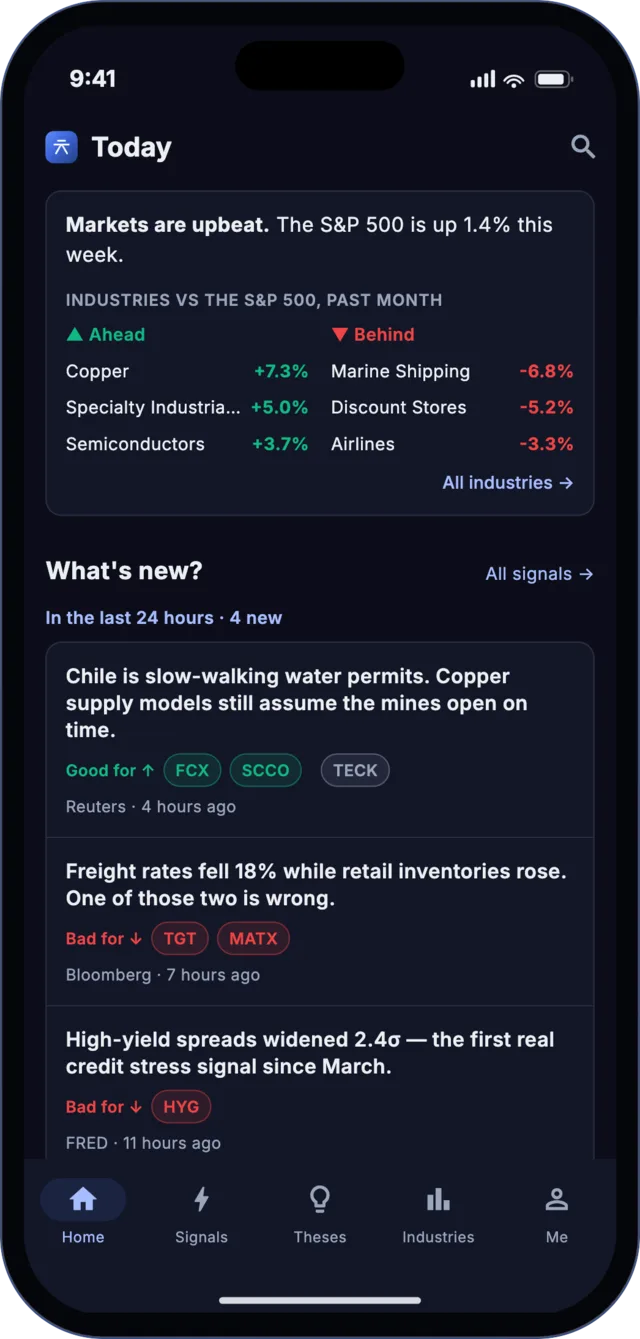
The same connections and theses as the website, on iPhone and Android. Turn on notifications and Tenji tells you each time it publishes a new connection, usually two or three a day.



New connection
now
Nvidia's CEO quits in a spy scandal, and rival Advanced Micro Devices could win cautious buyers
FAQ · For active traders
Frequently Asked Questions
How is this different from a news aggregator?
Aggregators give you more headlines. Tenji gives you fewer, better conclusions. It filters hundreds of articles down to the market-relevant ones, then does the analyst work: what it means, who it affects two steps downstream, and the strongest argument against the trade.
Are Tenji connections for day trading or swing trading?
Swing trading, mostly. Every connection is tagged with a time horizon: days, weeks, or months. Actionable connections have a clear catalyst and a short fuse, usually a few days to a couple of weeks. Deep Thesis connections are structural, multi-month plays. Nothing here is a 9:45 AM scalp alert. If you day trade, you can still use Tenji to know which names have a real catalyst behind them, as these names could have multiple days of follow through.
Is this financial advice?
No. Tenji is a research tool. It does not provide financial advice. It surfaces connections, reasoning, and context so you can do your own due diligence. Every trade decision (entry, exit, and position size) is yours. Trading involves substantial risk of loss.
What are earnings read-throughs?
An earnings print says more about a company's suppliers, customers and competitors than the headline number lets on. Tenji reads the reported figures, finds the adjacent name that a specific disclosure mechanically implicates, and explains the link. The reporter itself is never the traded name; the connection is.
What kind of strategy should I trade these connections with?
Whatever entry style you already trade. Tenji hands you the thesis: the ticker, the direction (long or short), the time horizon, and the reason the market is mispricing it. It does not hand you an entry, stop, or target, on purpose. Some traders buy the breakout, some wait for the pullback, some express it with options. The connection tells you what and why. Your system tells you when and how much.
Does Tenji give me entry, stop loss, and profit targets?
No, and that's deliberate. Tenji is a thesis machine, not a signal service. It records the price at publish time so every connection can be scored later, but position sizing and risk management are yours. If you don't have a risk framework yet, build that first. No connection feed fixes bad risk management.
How many connections will I get per day?
A handful, not a firehose. The pipeline runs four times a day (roughly pre-market, midday, after the close, and evening ET) and reads thousands of headlines, earnings reports, and macro signals. Almost everything gets rejected by the quality gates. What survives is the small set actually worth your attention.
What tickers does Tenji cover? Will I get illiquid junk?
No penny stock lottery tickets. Connections only publish if they resolve to names in nine major indexes: S&P 500, Nasdaq 100, Dow 30, FTSE 100, TSX Composite, Nikkei 225, DAX 40, Hang Seng, and NIFTY 50. Large, liquid names you can actually get in and out of.
Does Tenji do shorts, or longs only?
Both. Every related name carries the pressure Tenji expects on it — up, down, or watch — and the connection itself is marked bullish, bearish, or mixed. It is a map of where the story reaches, not an instruction to buy or sell.
How do I know which connections to prioritize?
Three ways. First, the tier: Actionable means high conviction with a live catalyst, Speculative means higher risk and higher reward, Deep Thesis means slow-burn structural. Second, every connection carries confidence and importance scores. Third, every connection includes the strongest case against the trade and a specific "what would make this wrong" falsifier. If the bear case reads more convincing than the thesis in your opinion, skip it. That's the point.
I already use a scanner and news alerts. What does this add?
Scanners tell you what's moving right now. News tells you what already happened. Tenji works two or three steps downstream: it maps the second and third-order effects of a headline and flags the names the market hasn't repriced yet. It's the difference between reacting with the crowd and positioning before the crowd connects the dots.
Do I need to watch the market all day to use this?
No. Tenji checks the news four times a day and posts new connections on the site and in the app. On mornings when there is something new, an email tells you what changed. Each one takes about a minute to read.
The first move is already priced in.
Start trading the second one.
Free to read. Sign in with Google to save connections and search.